Eagle Addition Diagnostic
Find out exactly what your Eagle addition will involve — free, in 48 hours.
Watch How It Works
Start Your Free Buildable Area Check
Already know you can build? Want a cost estimate?
If you have already verified the buildable area and need a cost band for your addition, use our dedicated Addition Budget Planner. Or explore other planners:
- Addition Budget Planner — for cost estimates on additions
- General Remodel Budget Planner — for interior remodels within the existing footprint
- Kitchen Remodel Budget Planner — for kitchen-focused projects
- Bathroom Remodel Budget Planner — for bathroom-focused projects
- ADU Feasibility Check — for accessory dwelling units (separate, self-contained living space)
What Eagle Homeowners Need to Know Before Adding On (2026)
Adding square footage to your home is fundamentally different from remodeling within the existing footprint. You're working with lot coverage rules, setbacks, foundation extensions, structural ties to existing framing, roof connections, and capacity questions for HVAC, electrical, and plumbing — on top of the renovation work itself. Below are the considerations that drive scope, cost, and timeline most often for Eagle additions.
Lot Coverage and Setbacks
Every Treasure Valley jurisdiction caps how much of your lot can be covered by structures, including the primary residence, additions, garages, sheds, and (in some zones) decks and porches. Before designing an addition, we verify:
- Maximum lot coverage allowed in your zone
- Current lot coverage (existing structures)
- Required front, side, and rear setbacks
- Any easements that further constrain buildable area
This is what the free Buildable Area Check answers — what you can actually add given your specific lot.
Foundation Strategy
Three main approaches, chosen based on existing foundation condition and addition geometry:
- Extend existing foundation — pour new footings and stem walls that match existing depth and tie in with new rebar. Most common.
- New independent foundation — addition has its own footings, isolated from existing. Used when existing foundation isn't viable or addition geometry doesn't align.
- Crawl space or basement extension — match existing crawl or basement depth, dig and frame to extend the conditioned space below grade.
Connection to Existing Home
Where the new addition meets the existing house is the most cost-sensitive interface. Considerations:
- Roof tie-in (matching pitch, weatherproofing the new ridge or valley, flashing)
- Wall connection (cutting in new framing, opening up existing wall to create flow)
- Floor transition (level matching, joist tie-ins)
- Siding match (color, material, age — older siding may not match new)
- Interior finish transition (matching baseboards, trim, flooring)
Mechanical Capacity Check
Adding square footage adds load. Three systems to evaluate before design:
- HVAC — will your existing furnace, AC, and ductwork serve the new area? Options include extending the existing system, adding a mini-split for the addition, or upsizing the entire system.
- Electrical service — does your panel have capacity for new circuits? Older homes with 100-amp service often need a service upgrade to 200-amp before adding significant square footage.
- Plumbing — does the existing supply and waste capacity support new fixtures? Critical if you're adding a bathroom or kitchen.
Permit Pathway (Eagle)
Additions almost always require a building permit. Process typically includes:
- Site plan + architectural plans (often requires licensed architect for additions over a certain size)
- Structural engineering stamp for any modification of load-bearing structure
- City of Eagle Planning and Zoning plan review (typical 3-6 weeks)
- Separate sub-permits for electrical, plumbing, mechanical
- Multiple inspections during construction
Historic Design Overlay
If your Eagle home sits in a Historic Design Overlay, any exterior change to a historic-contributing structure requires a Certificate of Appropriateness (COA). For additions this typically includes the addition itself, any window or door modifications on existing exterior walls, and siding choices that must match or complement the historic character.
What Drives Your Addition Cost
Every addition estimate is a function of these variables. Understanding them before you start collecting bids helps you scope realistically and compare apples to apples.
- Square footage being added. The biggest single driver. Cost per square foot varies by complexity, but volume scales linearly.
- Single-story vs. two-story addition. Two-story additions use the same foundation footprint for double the conditioned space — generally more cost-effective per square foot, but require structural engineering and roof tie-ins on multiple planes.
- Foundation type. Slab on grade is the simplest; crawl space adds excavation; basement adds significant cost but maximizes usable square footage per dollar.
- Roofline complexity. A simple gable matching the existing pitch is straightforward; a hip roof, valley, or complex multi-plane tie-in adds engineering and labor.
- Connection point complexity. A clean tie-in to an existing exterior wall is fastest. A connection that opens interior walls, changes circulation, or removes load-bearing structure adds scope.
- Mechanical capacity additions. If your existing systems need upgrading (panel, furnace, water heater), those costs stack on top of the addition itself.
- Selections grade. Builder vs. mid-tier vs. high-end can swing the finish cost 2–3x for the same square footage.
- Site access. Tight side yards, corner lots, mature landscaping, or limited equipment access add days to demo and rough framing.
DSC's diagnostic gives you a specific cost band for your addition based on your home's vintage, your lot, your existing systems, and your selections direction.
Recent DSC Additions
A sample of recent DSC addition projects across the Treasure Valley.
Sun Room Addition
Project type: Single-story sun room addition extending the existing living area into the backyard.
Scope highlights: New slab foundation extension, single-pitch roof tie-in to existing eave, large-window framing for daylight, electrical extension for lighting and outlets, HVAC integration via existing supply line. Designed for year-round use.
Master Suite Addition
Project type: Master bedroom and bath addition on an existing single-story home.
Scope highlights: Master suite footprint with new perimeter foundation, BCI I-joist subfloor system, 2×6 exterior walls, manufactured trusses matching existing roof pitch, master bathroom with custom tile shower, full bath fixture package, mini-split HVAC dedicated to the new suite.
Combo Project — Remodel + Addition + Shop
Project type: Existing 1988 home with kitchen and master suite remodel paired with small additions (master suite + kitchen bump-outs), a covered patio addition, and a 1,200 sq ft detached-feel shop addition with full electrical service.
Scope highlights: 153 sq ft master suite addition + 84 sq ft kitchen addition with new perimeter footings, stem walls, BCI I-joist subfloor system. 440 sq ft covered patio. 1,200 sq ft shop (30' × 40', 12' wall height) with R-21 walls, R-38 attic, R-10 rigid under slab, drywalled and fire-taped, 12' × 12' insulated roll-up door, new 400A meter base + 200A panel inside the shop, including 240V welder and EV-charger circuits. Demonstrates DSC's ability to handle whole-property modernization under one project.
What to Expect — Timeline & Process
A typical Eagle addition from first conversation to substantial completion runs 6–12 months. Permit review and design add 6–10 weeks to the front end. Below is the standard sequence.
- Free Buildable Area Check. You submit the form. Within 48 hours, we deliver a written diagnostic covering your lot's buildable area, setback constraints, foundation strategy options, mechanical capacity considerations, permit pathway, realistic timeline, and the questions to ask any contractor before signing.
- Discovery + design (6–12 weeks). Site walkthrough, scope refinement, architect coordination if needed, preliminary plans, structural engineering if required.
- Estimate + contract (2–3 weeks). Detailed line-item estimate with all subs priced. Contract signing locks scope, schedule, and budget.
- Permit + plan check (4–8 weeks). DSC pulls the GC permit; electrical, plumbing, and mechanical subs pull their own.
- Construction (varies by scope). Single-room addition: 8–16 weeks. Master suite or kitchen expansion: 12–20 weeks. Multi-room or two-story addition: 20–36 weeks. Project manager runs daily on-site coordination; weekly written updates plus Buildertrend access.
- Substantial completion + punch list (1–2 weeks). Final inspections, punch list walkthrough, completion certificate.
- Warranty. DSC's standard warranty covers labor and DSC-supplied materials.
Frequently Asked Questions — Eagle Additions
Do I need a permit for an addition in Eagle?
Yes, almost always. Any addition that adds conditioned space, modifies the building footprint, extends the foundation, or changes the roofline requires a building permit. The City of Eagle Planning and Zoning permit process typically takes 3-6 weeks once plans are submitted.
Do I need an architect for my addition?
For additions over a certain size threshold you will typically need either a licensed architect or qualifying designer. DSC has in-house design capability for most mid-complexity additions; we bring in licensed architects for larger projects or any structurally complex tie-ins.
How long does an addition take?
Plan for 6–12 months total from first conversation to substantial completion. Permit review and design add 6–10 weeks to the front end. Construction itself varies from 8 weeks for a single-room addition to 36 weeks for a major multi-room or two-story addition.
Can I live in my house during the addition?
Yes, in most cases. The addition is built outside the existing footprint, so most impact is in the yard. The exception is the connection-point work — when we cut into the existing exterior wall to tie the new space in, that's typically 1–2 weeks of significant interior dust and access disruption. Many homeowners vacate for that phase.
What is the difference between an addition and an ADU?
An addition expands your primary residence — more bedrooms, larger kitchen, master suite expansion, etc. An ADU (Accessory Dwelling Unit) is a separate, self-contained living unit with its own kitchen, bath, and bedroom for a tenant or family member. Different permit pathway, different zoning rules, different cost structure. DSC offers both — see our Eagle ADU page for that diagnostic.
How much does an addition cost per square foot?
It varies significantly based on the variables above (foundation type, roof complexity, mechanical capacity additions, selections grade). DSC's free Buildable Area Check gives you a specific cost band for your project based on your scope, your home, and your selections direction within 48 hours of submitting the form.
Do I need to upgrade my HVAC, electrical, or plumbing?
Maybe. Depends on your existing system capacity versus the load you're adding. DSC's diagnostic flags any mechanical capacity issues from the start so they don't become surprises mid-project.
How does the addition tie into my existing roof?
It depends on the addition's geometry and your existing roofline. Common approaches include matching the existing pitch and tying in at the eave, creating a new ridge that intersects the existing one, or designing a separate roof plane that visually integrates. DSC's design team works through this in the discovery phase before contract.
Adding On Outside of Eagle?
DSC serves the entire Treasure Valley. City-specific Additions pages are launching across our service area — Boise Additions, Meridian Additions, Eagle Additions, and Ada County Additions — along with our city ADU and Remodels pages.
What This Check Reviews
- Your lot's buildable area
- Setback requirements for additions
- Lot coverage limits in your zone
- Foundation strategy options
- Mechanical capacity considerations
- Permit pathway
- Realistic project timeline
What You Receive
- Property-specific buildable area analysis
- Setback and lot coverage assessment
- Foundation strategy recommendation
- HVAC, electrical, and plumbing capacity check
- Permit pathway and realistic timeline
- Initial cost band guidance
- Questions to vet any contractor
- Recommended next steps
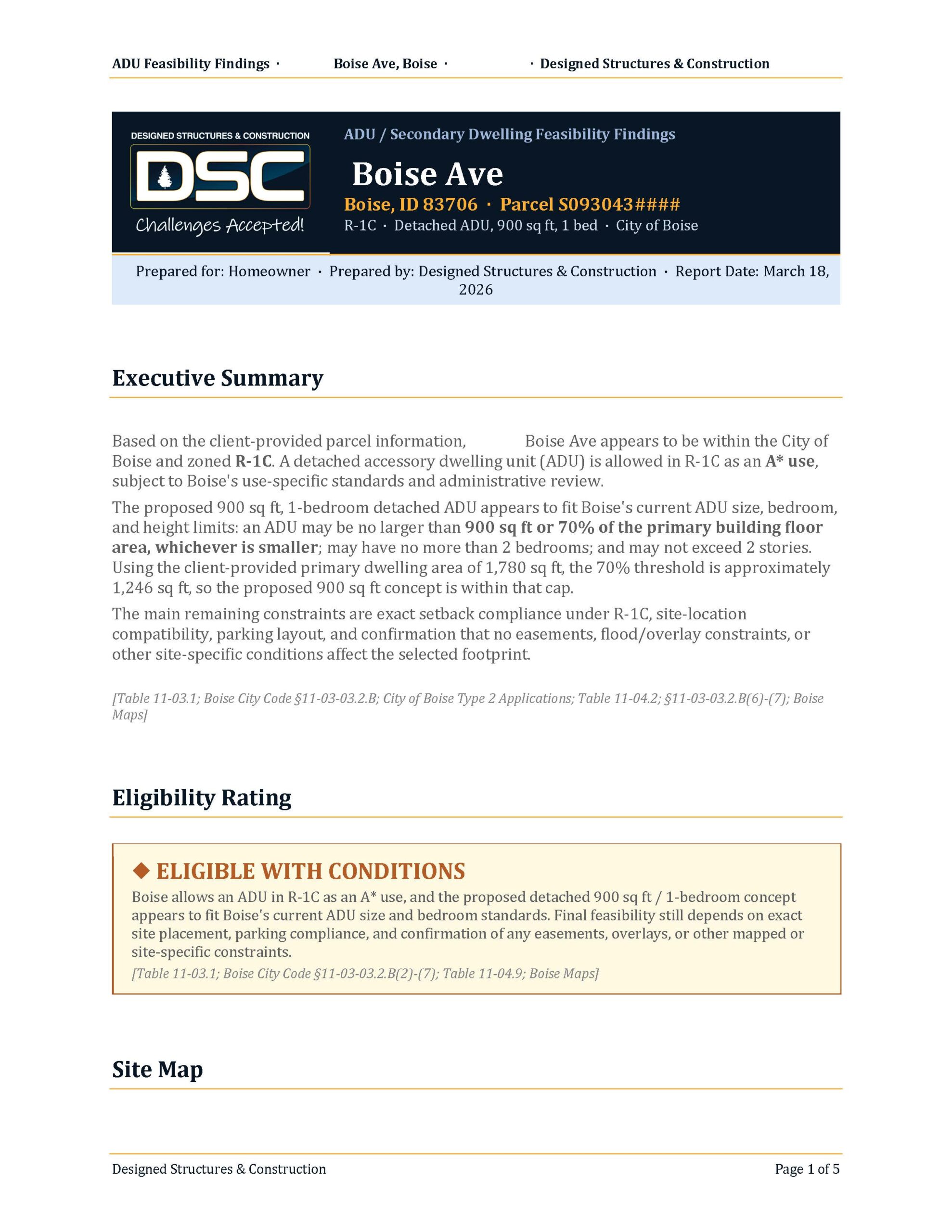
Your Personalized Report Includes:
A detailed, property-specific buildable area check designed to help homeowners understand whether their addition is feasible before spending money on architects, engineers, or contractor proposals. The report uses your actual property data from public records (year built, lot, zoning, setbacks, easements) to ground the analysis in your specific lot, not a generic Treasure Valley average. It covers your lot’s buildable area, foundation strategy options, mechanical capacity considerations, permit pathway, and the questions to ask any contractor before you sign.
The report surfaces the constraints that most often kill addition projects mid-design — lot coverage limits, setback conflicts, structural surprises, undersized mechanical systems — so you can plan around them rather than discover them after you’ve already paid for plans. And it includes initial cost-band guidance so you have a realistic budget framework before you start collecting contractor bids.
Why Trust Us With Your Project?
20+ Years Experience
Our highly trained team of professionals will guide you through your project. Our mission is to be highly organized, highly responsive and easy to communicate with.
280+ Projects
A wealth of experience helps DSC to see things in the project that most others would miss. We host a comprehensive understanding of many construction techniques used over the years and we know how to spot a previous owners DIY fix that may lead to complications.
Licensed & Insured
Our certifications are far in excess of a standard General Contractors Registration with the State. Our team hosts a variety of college degrees, Professional Certifications such as PMP and many other trade certifications.
Local Boise Experts
Knowing the area helps us to understand local codes and requirements of the Planning and Building Departments as well as common construction techniques that were executed in the area over its many years of growth.
Ready to Get Started?
A 48-hour, property-specific buildable area check before you spend a dollar on architectural plans, engineering, or a contractor visit. Free, no obligation, and yours to keep — even if you decide to work with another contractor. Submit the form below to get started.

Quick Links
- © 2025 All Rights Reserved
- Designed Structures & Construction (DSC)